
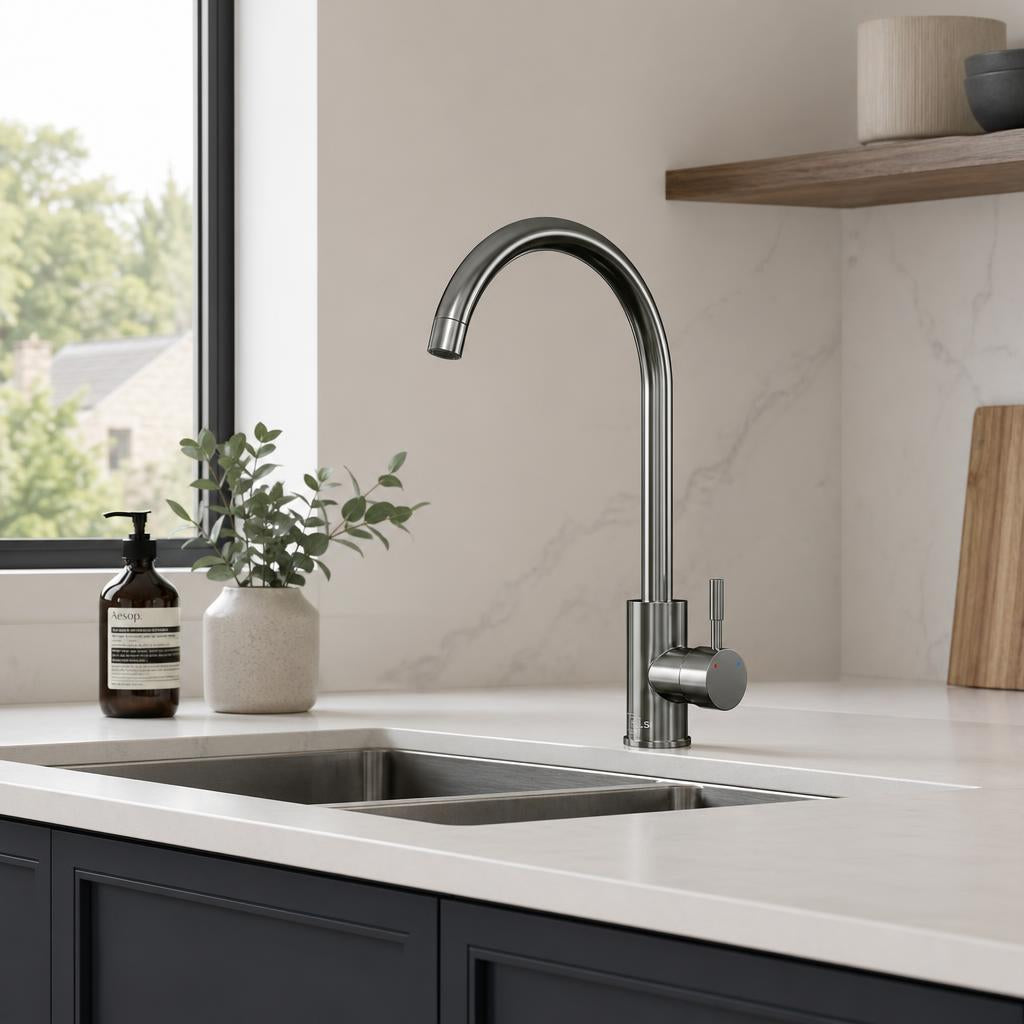
The Journal · Buyer's Guide
What Makes a Good Kitchen Tap? A Buyer's Guide to Quality (and What to Avoid)
A kitchen tap is the hardest-working thing in your home — touched dozens of times a day. Here's how to tell a good one from an expensive-looking dud.
Most people choose a kitchen tap on looks alone, then wonder two years later why the finish has flaked or the spray has weakened to a dribble. The truth is that a good kitchen tap is mostly about what you can't see — the cartridge inside, the quality of the metal, the way it's been built to cope with British water. Get those right and a tap lasts decades. Get them wrong and you're back tap-shopping far sooner than you'd like.
Here's what actually separates a quality kitchen tap from a pretty one — and the warning signs worth watching for before you buy.
1. What's inside matters more than what's outside
The single most important part of any tap is the cartridge — the small valve that controls the flow. A good ceramic disc cartridge will open and close smoothly tens of thousands of times without dripping. A cheap one is the reason taps start leaking. When you're comparing taps, this is the part to ask about, even though no one ever photographs it.
The second is the body. Solid brass is the gold standard — heavy, durable, and naturally resistant to corrosion. Lightweight taps made from zinc alloy or thin pressed metal feel hollow in the hand and don't last. A genuinely good tap has a reassuring weight to it.
A tap's looks sell it once. Its cartridge is what you live with for the next fifteen years.
2. The finish has to survive real life
A kitchen tap gets splashed, wiped and grabbed with wet hands all day. A quality finish — properly applied over solid brass — resists fingerprints, water spots and wear. A cheap finish is sprayed thinly over poor metal and starts to cloud or peel within a couple of years, usually right where your hand lands. This is why a slightly better tap is almost always the cheaper choice over time.
3. It has to be made for British water
Much of the UK has hard water, and our mains pressure varies enormously from home to home. A tap designed and approved for British conditions — with WRAS-approved internals — is built to cope with our water safely and reliably. It's an easy thing to check and an important one: it's the difference between a tap that performs as promised and one that struggles from day one.
Signs of a good tap
- Solid brass body with real weight
- Ceramic disc cartridge
- WRAS-approved internals for UK water
- A proper guarantee on the body
- A finish rated for daily wear
Warning signs to avoid
- Suspiciously lightweight — usually zinc alloy
- No mention of the cartridge type
- Vague or missing guarantee
- No water-pressure guidance
- A finish that's "coated" rather than properly applied
4. Match the tap to how you actually cook
Beyond build quality, a few practical questions save regret. Do you need a pull-out spray for rinsing and filling pots? Is your window behind the sink, meaning you need a tap that clears the sill? Do you want a single lever for one-handed use with messy hands? The most beautiful tap in the world is the wrong one if it fights your daily routine.
See It In Practice: The Bidbury & Co Tap Clearance
Our current designer tap clearance is a good way to see quality up close — solid construction, WRAS-approved internals and finishes built to last, now up to 60% off while stocks last.
View The Tap Sale Browse All TapsSo, what should you spend on a kitchen tap?
Quality kitchen taps generally start around the £180 mark and rise from there with design and finish. Below that, you're often paying for looks over longevity. The sensible play, as we always say, is to buy the best tap you comfortably can — ideally catching a good one in a sale — because it's a piece you touch every single day and replace rarely. It's the definition of money well spent.
Frequently asked questions
What should I look for when buying a kitchen tap?
Prioritise a solid brass body, a ceramic disc cartridge, WRAS-approved internals suited to British water, and a clear guarantee. A quality tap has noticeable weight to it. Avoid very lightweight taps and any that don't tell you what's inside.
How much should a good kitchen tap cost?
Quality kitchen taps typically start around £180 and rise with design and finish. Below that you often trade longevity for looks. Buying a better tap in a clearance sale is the smartest way to get quality affordably.
What does WRAS-approved mean?
It means the tap's water-touching parts meet UK regulations for use with mains drinking water — an assurance the tap is built to perform safely and reliably with British water.
Why do cheap kitchen taps fail?
Usually because of a poor-quality cartridge, which causes dripping, and a thin finish over weak metal, which clouds or peels. Both are hidden at the point of sale, which is why build quality matters more than appearance.
Ready to choose a tap worth keeping? Browse our designer tap clearance or explore the full collection.
%0AA%20kitchen%20tap%20is%20the%20hardest-working%20thing%20in%20your%20home%20%E2%80%94%20touched%20dozens%20of%20times%20a%20day....)
Leave a comment
This site is protected by hCaptcha and the hCaptcha Privacy Policy and Terms of Service apply.